
Try our newest merchandise


“If you’re keen to have a look at one other particular person’s conduct towards you as a mirrored image of their relationship with themselves moderately than a press release about your worth as an individual, then you’ll, over time, stop to react in any respect.” ~Yogi Bhajan
A number of years in the past, I hiked into the distant forestlands of Bukidnon, a mountainous province within the southern Philippines. I used to be there to make a documentary concerning the Pulangiyēn folks, an Indigenous neighborhood residing within the village of Bendum. No roads led there. No operating water. Only a winding path upwards, a slow-moving carabao pulling my digicam gear, and some kindhearted villagers serving to me climb.
I had include the intention to hear—to watch every day life, report sounds, and be taught what I may. What I didn’t know was that one in every of my deepest classes would come not from the forest or the folks, however from a spider.
A really giant spider. Furry. Large and spidery.
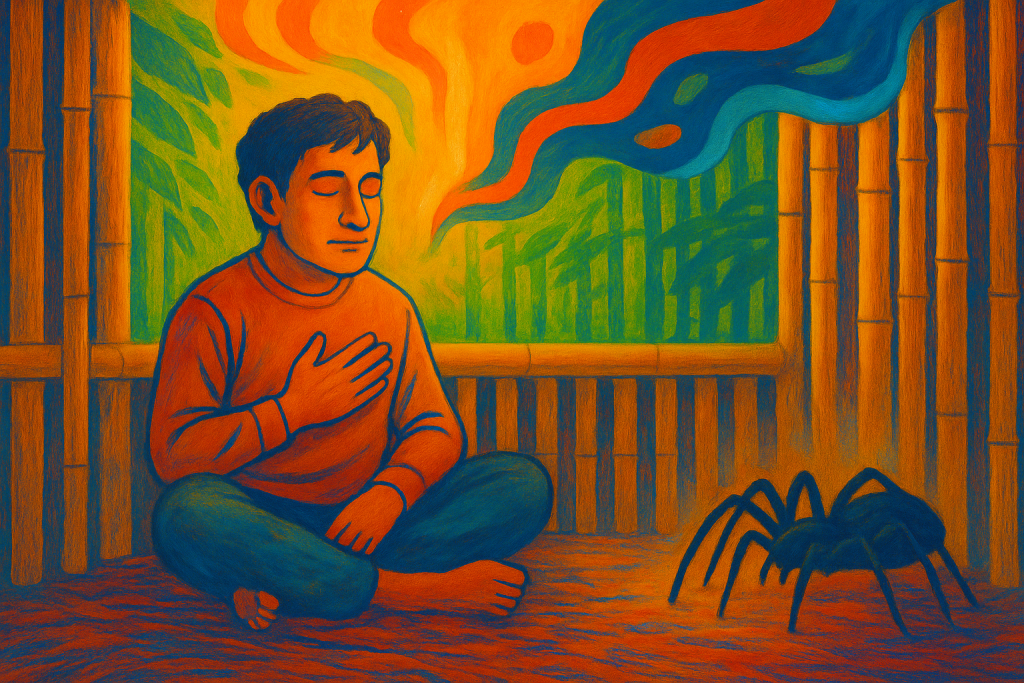
My lodging was a small, hand-built hut with bamboo partitions and a woven ground mat. I felt honored to remain there, grateful for the simplicity and peace and the respite from the rains. However my gratitude dimmed somewhat once I observed, down on the ground within the nook of the room, a darkish form—a spider. Immobile. The scale of my outstretched palm.
I requested one of many locals if it needs to be, nicely… eliminated.
They smiled gently. “It lives there,” they stated.
That was it. No concern. No plan to catch it in a cup and carry it away. The spider wasn’t an issue. In reality, to intervene may need been seen as disrespectful—not solely to the spider, however to the spirits believed to dwell in all issues, seen and invisible.
So I had a selection: coexist or reside in worry.
The Problem of Coexistence
At first, I couldn’t sleep. Each creak of bamboo startled me. I imagined the spider descending on my face in the midst of the night time. However day after day, the spider by no means appeared to maneuver round a lot; not less than I used to be not conscious of any main roaming round by the beast. And slowly, I started to surprise—what precisely was I afraid of?
It wasn’t simply the spider. It was the unknown. The lack of management. The sensation of being susceptible in a spot removed from what I understood.
However right here’s what I discovered: coexistence is just not about settlement or consolation. It’s about selecting to not reject or destroy what we don’t but perceive. It’s about pausing lengthy sufficient to see whether or not what we worry is really harmful—or whether or not it’s simply unfamiliar.
That spider turned a mirror.
Worry Isn’t All the time a Downside to Remedy
Over time, my relationship with the spider shifted. I ended checking the nook obsessively. I nonetheless observed it, however I didn’t react. I ended making an attempt to guard myself from one thing that wasn’t truly threatening me.
Within the quiet of these forest nights, I started to consider all the opposite issues I’d tried to keep away from or management in life—conversations, feelings, uncertainties, even my very own sense of failure. The sample was the identical: discomfort would come up, and I’d attempt to evict it.
However this expertise confirmed me a unique approach: you don’t at all times want to resolve the worry. Typically, you simply want to sit down with it. Let it keep within the nook.
And over time, your relationship to the worry adjustments. You develop bigger round it.
Within the Indigenous worldview of the Lumad folks, coexistence isn’t an summary idea—it’s life. Bushes, rivers, stones, animals—every thing has a presence, a job, a spirit. You don’t have to love each being you share house with. You simply need to respect it.
That is echoed in lots of traditions. In Buddhism, the follow of metta encourages us to increase loving-kindness not solely to buddies however to enemies, strangers, and even issues that scare us. In fashionable mindfulness follow, we be taught to watch our expertise with out judgment, to permit ideas and sensations to return and go.
Even ecology tells us: thriving methods are numerous, and stability depends upon the peaceable presence of all issues—even spiders.
What I Inform My College students Now
I’ve taught filmmaking and storytelling for a few years. My college students typically wrestle with worry—worry of being seen, of not being adequate, of creating errors. Earlier than, I attempted to educate them out of it. Now, I train them to make room for it.
I inform them concerning the spider.
I inform them concerning the time I shared a hut with one thing I used to be afraid of—and the way, by coexisting with it, I modified greater than it did. The worry didn’t go away. However it stopped operating the present.
So the subsequent time one thing in your life scares you—not as a result of it’s dangerous, however as a result of it’s unfamiliar—see in case you can let it keep within the nook a short time longer. Don’t push it away. Don’t choose your self for feeling it. Simply breathe.
Let or not it’s there.
You may uncover, like I did, that peaceable coexistence is feasible—even with the belongings you by no means thought you possibly can settle for.
And when you be taught that, there’s little or no left to worry.
About Tony CollinsTony Collins, EdD, MFA is a documentary filmmaker, trainer, musician, author, and advisor with forty years of expertise. His work explores artistic expression, scholarly rigor, and nonfiction storytelling throughout the USA, Central America, Asia, and the UAE. In 2025, he’s self-publishing Artistic Scholarship: Rethinking Analysis in Movie and New Media on Amazon, difficult conventional educational evaluation in movie and new media. Web site: anthonycollinsfilm.com
See a typo or inaccuracy? Please contact us so we will repair it!