

Take a look at our newest merchandise


“AI by accident made me consider within the idea of a human soul by exhibiting me what artwork seems to be like with out it.” ~Unknown
What’s intelligence?
I’ve requested this query all my life—as a instructor, a filmmaker, a researcher, and now, as somebody dropping my imaginative and prescient to macular degeneration.
I ask it once I watch college students discover their voice.
I ask it once I hearken to a detailed pal of mine, a world-renowned cosmologist, whose information appears limitless however whose humility runs even deeper. He can talk about black holes one minute and quote the Tao Te Ching the subsequent. He doesn’t simply know information—he is aware of find out how to pay attention. He is aware of find out how to clarify one thing sophisticated with out making you’re feeling small. That, to me, is actual intelligence.
And but… I’ve began to note one thing unusual.
Synthetic Intelligence is starting to resemble folks like him. It may possibly write fluent sentences. It may possibly summarize books I haven’t learn. Typically, it surprises me. And I discover myself questioning: is this additionally intelligence?
What AI Will get Proper—and What It Will By no means Really feel
Let me say this clearly: I’m grateful for AI. This very essay was formed with its assist. I’ve superior macular degeneration. Proofreading my very own writing is tough—typically unattainable. Instruments like this will not be a luxurious for me. They’re a present. A lifeline. With out them, I wouldn’t be capable of preserve writing. For that, I’m grateful.
However there’s a form of intelligence that AI won’t ever know.
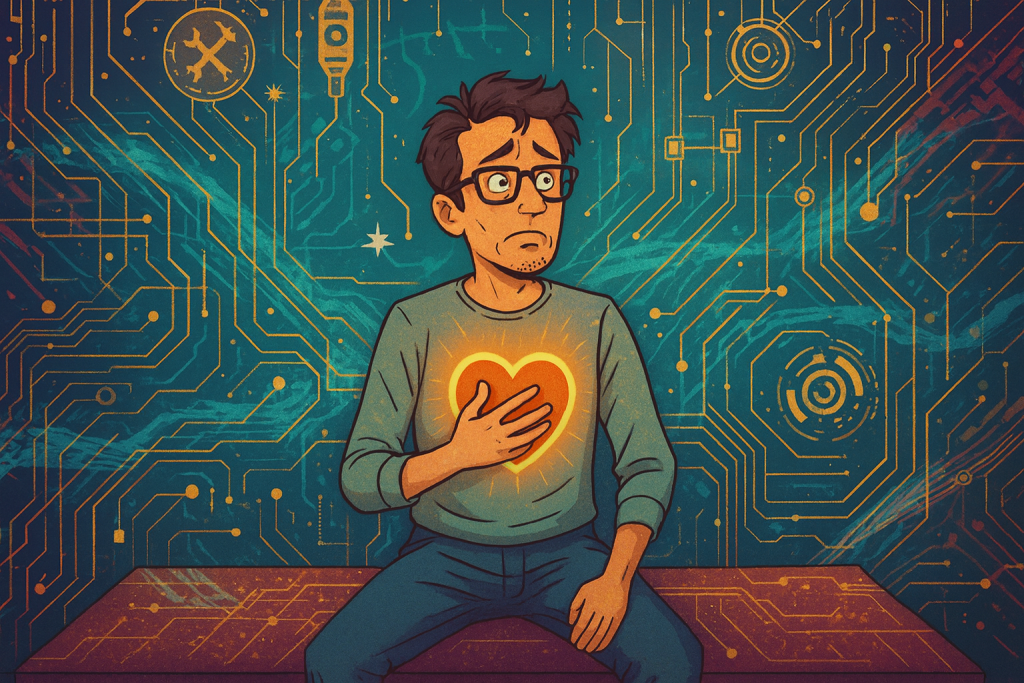
It received’t really feel the panic of forgetting your traces onstage, or the push of remembering them mid-breath. It doesn’t lie awake at night time questioning whether or not your work issues. It doesn’t weep when your mom now not remembers your title. It doesn’t get nervous earlier than a job interview. It hasn’t failed, or recovered, or beloved.
It may possibly assist categorical a sense, however it can not have one.
A Software, not a Thoughts
We name it “synthetic intelligence,” however it’s extra like synthetic fluency. It’s quick. It’s competent. It may possibly impress you. However it doesn’t know in the way in which we all know. It hasn’t spent years working towards an instrument in the dead of night or educating a pupil who doesn’t consider in themselves—till someday, they do. It doesn’t develop from expertise.
It doesn’t grieve. It doesn’t heal. It doesn’t change.
So when folks say, “AI goes to switch us,” I all the time marvel—which a part of us? The half that fills out varieties and writes experiences or does different rutinary duties? Possibly. However the half that authentically and truthfully tells a narrative nobody else can inform? By no means.
Instructing College students to Present Up
In each class I’ve taught, I’ve stated some model of this:
“Don’t cease on the analysis. Don’t cease at what AI offers you. Study to point out up in your work.”
Some college students disguise behind info. It’s safer. However I inform them: you are the which means. You’re the perception. You’re the threat.
I as soon as had a pupil who wrote a technically flawless paper. However it had no voice. Once I requested her what it meant to her, she hesitated. Then she advised me about her father, who had lived by means of the conflict the paper was about. Her whole relationship to the subject shifted in that second. That was the true intelligence. Not the citations. Not the syntax. The braveness to talk from the guts.
When Sight Fades, One thing Else Comes into View
Dropping your imaginative and prescient is not only about studying much less. It’s about seeing in a different way. It’s about slowing down. Listening extra. Studying to belief what you’ll be able to’t confirm together with your eyes.
It has additionally deepened my appreciation for instruments like AI. I depend on them each day. However I additionally discover their limits. They assist with kind, however not with essence. They clear the window, however they’ll’t present you what’s outdoors. That also requires you.
Intelligence Is Not the Identical as Knowledge
My sensible cosmologist pal as soon as advised me, “The extra I be taught, the extra I understand how little I perceive.”
AI doesn’t say issues like that.
It doesn’t know humility. Or thriller. Or awe.
Intelligence, within the deepest sense, is just not about management or solutions. It’s about how we stock ourselves in uncertainty. It’s about grace underneath stress. Presence in ache. Humor in despair. Kindness with out reward. None of that exhibits up in a immediate.
The Remaining Lesson: Instruments Don’t Change Soul
If there’s one factor I’ve discovered—by means of educating, by means of imaginative and prescient loss, by means of utilizing AI—it’s this:
A device may help you construct one thing. However it will probably’t inform you why it issues.
So sure, use the instruments. Use AI. Let it help you. I do.
However always remember: you might be greater than the device. You’re the story behind the sentence. The silence between the notes. The rationale the work issues in any respect.
That’s not synthetic. That’s actual.
And it’s irreplaceable.
About Tony CollinsTony Collins is a documentary filmmaker, educator, and author whose work explores creativity, caregiving, and private development. He’s the creator of: Home windows to the Sea—a transferring assortment of essays on love, loss, and presence. Inventive Scholarship—a information for educators and artists rethinking how artistic work is valued. Tony writes to replicate on what issues—and to assist others really feel much less alone.
See a typo or inaccuracy? Please contact us so we are able to repair it!